The Value of Dedicated Pick and Pack Services for Growing Brands
If you've ever stood in your garage surrounded by shipping boxes at 11 p.m. trying to get orders out before pickup, you understand why growing brands look for help. As order volume climbs, getting the right product into the right box stops being simple. This is where dedicated pick and pack services come in, and understanding their value can be the difference between a brand that scales smoothly and one that gets buried under its own growth.

Table of Contents
What Pick and Pack Actually Means
Pick and pack is exactly what it sounds like. A worker pulls the right products off a shelf for an order, packs it into a box, and ships it to the customer. It sounds simple, and for a handful of orders a week, it is. The trouble starts once you're handling dozens or hundreds of orders a day, each with different products and packaging needs.
This is the core function of any ecommerce warehouse, and it's also the part of the business customers notice most. They see whether the right item showed up, on time, in good condition.
The Hidden Complexity Behind a Simple Process
A basic pick and pack workflow involves inventory tracking, order verification, packaging selection, and label printing, all happening at once. Add seasonal spikes and multiple sales channels, and it's easy to see why brands managing this in-house hit a wall.
Why Growing Brands Struggle With Fulfillment
Most founders don't start a brand because they love packing boxes. They start because they believe in a product. But once orders arrive faster than one or two people can handle, fulfillment becomes a second job nobody signed up for.
Space becomes a problem first, as inventory takes over a spare bedroom, then a storage unit, then a garage. Staffing becomes a problem next, since pick and pack work requires consistent labor, especially during busy seasons. Eventually mistakes creep in: wrong items get shipped, orders go out late, and customer service tickets pile up.
It's easy to underestimate how much time and money self-fulfillment consumes. Between packaging, labor, software, and the opportunity cost of founders doing manual work instead of growing the business, the math rarely favors staying in-house as volume grows.

Pick and Pack Creates Faster Order Flow
One of the clearest benefits of working with a dedicated provider is speed. Pick and Pack Creates Faster Order Flow because a trained team, an organized warehouse layout, and purpose-built systems move orders through the process far more efficiently than a small in-house team juggling multiple roles.
When picking, packing, and shipping happen in a coordinated sequence rather than whenever someone has a free moment, orders move from received to shipped in hours instead of days. Customers expect fast turnaround and treat slow shipping as a reason to shop elsewhere. It also shapes how customers feel about a brand: a customer who receives their order quickly is more likely to return and recommend the brand to others.
How Pick and Pack Improvements Reduce Costly Mistakes
Order accuracy doesn't get much attention until it becomes a problem. Best-in-class fulfillment operations run at 99.5 to 99.9% accuracy, and anything below 99% is considered a red flag at scale.
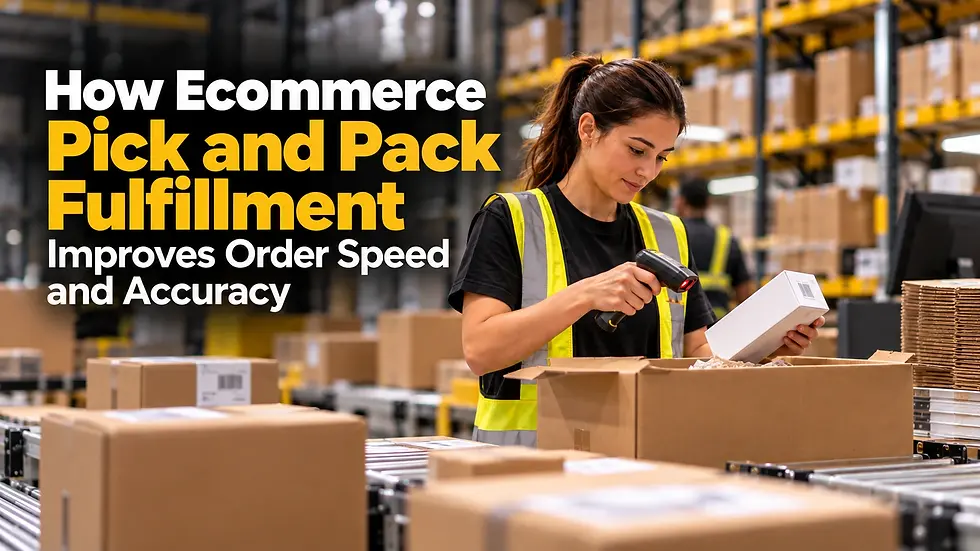
Pick and Pack Improvements like barcode scanning at each stage catch errors before they leave the warehouse. When employees scan SKUs at every stage of fulfillment, the system can verify the correct item and quantity are being handled, a level of quality control that's hard to match manually.
A single wrong shipment doesn't just cost the price of reshipping an item. It costs a customer service ticket, time spent resolving the complaint, and often the customer's willingness to order again. Customer loyalty is genuinely at stake, since 17% of customers will abandon a brand after just one bad experience.
Kitting and Other Specialty Services
As brands grow, fulfillment needs often become more complex than shipping single items. Kitting fulfillment is one example: combining multiple individual products into a single packaged unit before it ships, like a skincare set with three products bundled together, or a subscription box with several components.
Handling kitting in-house is time-consuming and easy to get wrong, especially when combinations change for promotions or seasonal offers. A fulfillment company with kitting capabilities can assemble these bundles ahead of time, so an order ships as a ready-made unit instead of requiring last-minute assembly. Many providers also offer custom packaging, branded inserts, and quality checks during the pack process, touches that shape how a customer experiences unboxing a product.
How a 3PL Helps You Reduce Shipping Cost
Shipping costs add up fast, and they're one of the biggest line items in any ecommerce budget. Established 3PL fulfillment companies negotiate shipping rates across a high volume of packages, resulting in lower per-package costs than a brand could secure alone. This is part of why partnering with a 3pl can reduce shipping cost in ways that aren't obvious until you see it on a monthly invoice.
Where your inventory sits also affects shipping cost. An ecommerce fulfillment warehouse closer to your customer base means shorter shipping distances, often translating to lower rates and faster delivery. Some providers also support global pack and ship and express pack and ship options for brands reaching customers internationally or working with tighter delivery windows.
Recognizing the Value of Dedicated Pick and Pack Services
Not all pick and pack fulfillment services are built the same way, so it's worth evaluating a potential partner carefully. Look at their technology, track record with order accuracy, and how transparent they are about pricing.
It also helps to ask how they handle the full pick pack ship process, from receiving inventory to handing packages off to a carrier. A provider that treats pack and ship as one connected workflow, rather than disconnected steps, tends to deliver more consistent results for growing brands. That's really the heart of the value of dedicated pick and pack services: a partner who treats your orders with the same care you would, at a scale you couldn't manage alone.

How FlatOut Fulfillment Supports Growing Brands
FlatOut Fulfillment works with brands ready to move past garage shipping and into a dependable fulfillment setup. The team focuses on accuracy, speed, and clear communication, so founders can spend their time growing the business instead of taping boxes.