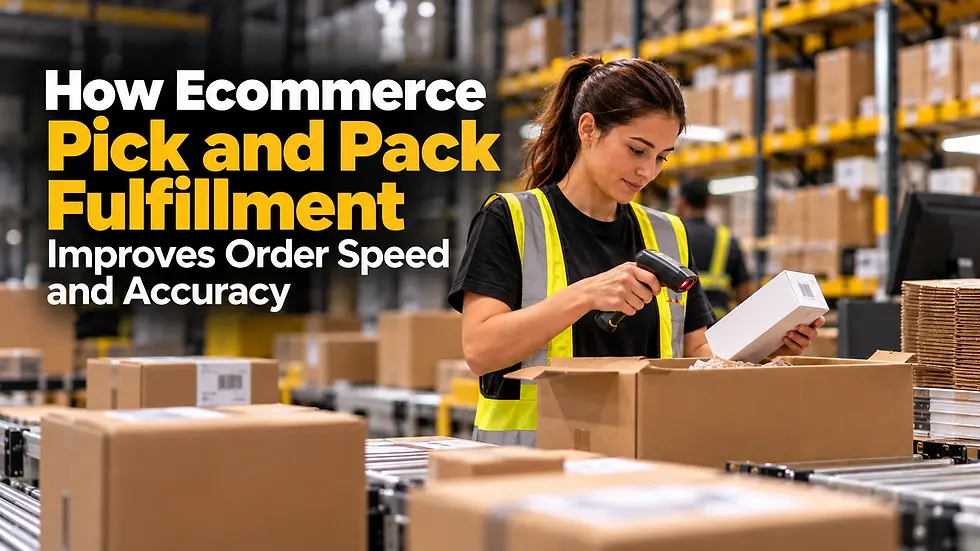
The Role of Pick Pack and Kitting in Ecommerce Fulfillment
Ecommerce fulfillment can feel overwhelming as your business grows and customers expect orders to arrive fast and exactly right. One part of the process that often gets overlooked is what happens between the click on "buy" and the box leaving the building: picking the items, packing them, and, when products ship together, kitting them. Done well, these steps decide whether you win repeat customers or lose them to the competition.
This guide explains how pick pack and kitting work, how they affect your costs and accuracy, and when it makes sense to hand them off to a fulfillment partner.

Table of Contents
What Is Pick Pack and Kitting in Ecommerce Fulfillment?
Pick pack and kitting are the three hands-on steps that turn an online order into a finished package. Picking selects the right items from inventory, packing prepares them for shipping, and kitting combines several products into one ready-to-ship unit. Each step feeds the next, so a mistake early on tends to travel all the way to the customer's door.
Picking
Picking is the process of pulling the correct products and quantities from storage locations to fill an order. Warehouses use a few methods. Discrete picking handles one order at a time, batch picking collects the same item for several orders at once, and zone picking splits the building into sections so each worker covers one area. Barcode scanners confirm each item so a wrong product is caught on the spot.
Packing
Packing is where selected items are checked, placed in the right box with protective material, sealed, labeled, and handed to a carrier. A good pack station verifies the contents against the order one last time, which is a big reason a quality pick pack ship process produces so few wrong shipments. Packers also add packing slips, inserts, or return labels at this stage so the box arrives complete.
Kitting
Kitting bundles individual items into a single package that is tracked as one product, such as a gift set or subscription box. Each kit has a list of components, and the system subtracts them from inventory automatically when the kit ships.

Why Efficient Picking Matters in Your Ecommerce Warehouse
Efficient picking matters because it controls how fast orders leave the building and how often they leave wrong. Picking is usually the most labor-intensive step of order fulfillment, since workers spend much of their time walking between locations.
A well-organized ecommerce warehouse reduces that walking. Best sellers sit close to the pack stations, similar products are not stored right next to each other so they do not get mixed up, and every location is labeled and scannable. Those small details add up to shorter pick times and fewer errors, which speeds up delivery and improves the customer experience without any extra spending on shipping.
Smart Packing Cuts Shipping Costs and Damage
Smart packing lowers your shipping bill because carriers charge based on box size and weight, not only on what is inside. A box that is too big for its contents can trigger dimensional weight pricing, which means you pay for the space even though it is empty.
Right-sizing the box, choosing the right protective material, and packing efficiently avoids that waste. It also protects products on the way, since a snug fit with proper cushioning reduces damage, returns, and replacement shipments. Customers notice well-packed orders too, and a clean unboxing is often their first physical impression of your brand.
Kitting Turns Bundles Into a Sales Strategy
Kitting turns bundles into a sales strategy because it lets you offer limited-time sets, seasonal deals, subscription boxes, and personalized product kits without slowing down fulfillment. Instead of a picker collecting five separate items for every bundle order, the kit is prepared in advance and picked as a single item. Product kitting also adds a quality check, since every component is verified once during assembly.
That setup speeds up processing and often lowers packaging and labor costs per order. It also gives you room to be creative. You can launch a holiday gift set or a starter kit for new customers, knowing the warehouse can build and ship it consistently. Custom kits, such as a set tailored to a customer's needs, can set your brand apart in a crowded market.
Where the Cost Savings Come From
Running a lean operation matters in ecommerce, and pick pack and kitting save money in a few specific ways. Each one comes down to doing less work per order and getting more of it right the first time.
Better inventory management: Scanning at every step keeps counts precise, which helps you avoid both overstock and stockouts.
Faster processing: Organized picking and ready-made kits move orders from shelf to carrier in less time.
Fewer reshipments: Accurate order handling means fewer wrong items, damaged packages, and refunds.
Smarter packaging: Right-sized boxes and consolidated kits lower the shipping cost of each order.
Taken together, these gains often matter more than any single rate you negotiate with a carrier, because they reduce cost on every order instead of one line item. They also compound as your volume grows.

When Should You Outsource to a Fulfillment Partner?
You should consider outsourcing when picking, packing, and kitting start taking more time and space than you can spare. Doing it in-house can be complex and costly, especially once orders climb, and the hours spent in the packing area are hours not spent on marketing, product development, or customer service.
A reliable fulfillment company brings trained staff, scanning technology, and established processes that are hard to build on your own. Experienced 3PL fulfillment companies can also absorb peak season surges without sacrificing accuracy, and the same pack and ship workflow keeps working as volume climbs, which helps reduce returns and protect your reviews.
Choosing a provider is easier when you know what to ask. A few questions are worth raising before you sign:
What is your order accuracy rate, and how do you handle errors?
Do you offer kitting and custom packaging in-house?
How does your software connect to my store and track inventory?
How do you handle seasonal surges?
Look for an ecommerce fulfillment warehouse that can show you how its pick and pack services work in practice, not just describe them. Clear answers on process and pricing are a strong sign you are talking to a provider that will actually perform.
How FlatOut Fulfillment Handles Pick, Pack, and Kitting
Pick, pack, and kitting are central to any successful ecommerce fulfillment strategy, and partnering with a provider that does them well lets you reduce costs while keeping customers happy. FlatOut Fulfillment manages inventory in our ecommerce warehouse and handles each order with care, from the first pick to the final shipping label.