
Essential Steps to Prepare Your Business for Peak Shipping Seasons
Every year, businesses across the country find themselves scrambling when peak shipping seasons hit. Orders spike, carriers get stretched thin, and the pressure to deliver on time becomes very real. Whether you're gearing up for the holiday rush, back-to-school season, or another high-volume period, taking the time to prepare your business for peak shipping seasons well in advance makes all the difference between a smooth operation and a chaotic one.

Table of Contents
When to Prepare Your Business for Peak Shipping Seasons
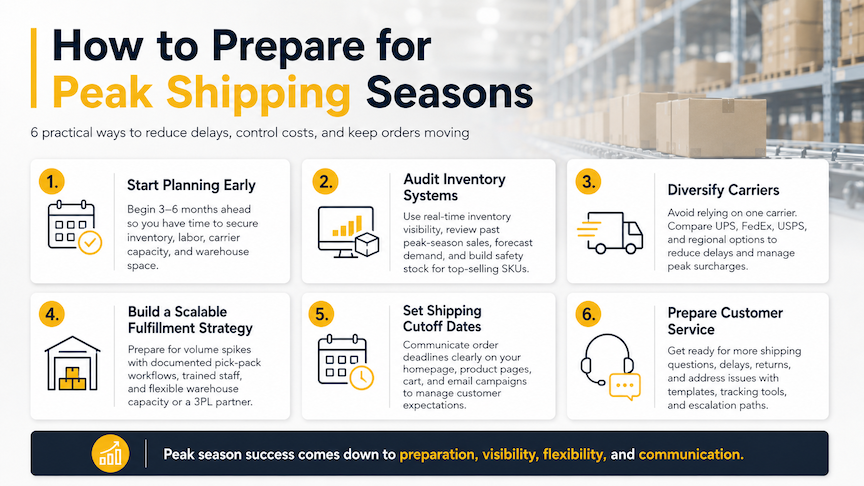
A common mistake businesses make is waiting until a few weeks before a busy period to start preparing. By that point, carriers have already set their capacity limits, warehouses are filling up, and you're already behind. The most successful ecommerce brands start their peak season logistics planning three to six months out, sometimes earlier.
Think about what you need to have in place: staffing, inventory levels, carrier agreements, warehouse space, and a clear operational playbook. None of those things come together overnight. Getting a head start gives you time to identify weak spots in your supply chain and fix them before orders start flooding in.
Audit Your Inventory Management System
Before peak season arrives, take a close look at how you're managing inventory. If you're still tracking stock in spreadsheets or relying on manual counts, that's a risk you don't want to carry into a high-volume period.
A solid inventory management system should give you real-time visibility into stock levels, help you forecast demand based on historical data, and flag potential stockouts before they happen. According to the National Retail Federation, holiday retail sales consistently grow year over year, which means demand forecasting accuracy matters more each season.
Steps to Strengthen Your Inventory Process
Review your sales data from the past two or three peak seasons and look for patterns. Which SKUs moved fastest? Where did you run out of stock? Were there items you over-ordered that tied up cash? Use those answers to build smarter purchase orders this time around.
Also, consider safety stock. Adding a buffer on your top-selling items reduces the risk of stockouts during unexpected demand surges, which happen more often than people expect during the holiday season.
Strengthen Carrier Relationships and Diversify Your Options
Relying on a single carrier during peak season is one of the riskier things a business can do. Major carriers like UPS, FedEx, and USPS routinely hit capacity limits during the holidays, and businesses without backup options can find themselves with packages sitting idle and customers frustrated.
Start conversations with your carrier reps early in the year. Ask about volume commitments, surcharge schedules, and service guarantees. Carrier peak surcharges can significantly increase your shipping costs if you're not accounting for them in advance, so it's worth building those numbers into your pricing model before the season hits.
Diversifying across two or three carriers also gives you flexibility. If one carrier experiences delays or capacity issues, you have options rather than bottlenecks.
Build a Scalable Fulfillment Strategy
Your fulfillment operation needs to be able to handle volume spikes without falling apart. That means having a plan for both the expected surge and the unexpected one.
Staffing and Warehouse Capacity
If you run your own fulfillment, think about temporary staffing well in advance. Labor is notoriously tight during the fourth quarter, and temp agencies fill up fast. Alternatively, many businesses find that partnering with a third-party logistics provider (3PL) gives them on-demand scalability without the overhead of managing warehouse staff themselves.
Make sure your picking and packing processes are documented and repeatable. When you're onboarding temp workers or handling three times your normal order volume, efficiency matters. Streamlined workflows and clearly labeled storage locations can shave meaningful time off each order.
Technology and Automation
Look at where manual processes are slowing you down. Barcode scanning, automated shipping label generation, and order management integrations with your sales channels are all areas where a one-time setup pays off heavily during high-volume periods. ShipStation and similar platforms can consolidate orders from multiple sales channels into a single dashboard, which reduces errors and saves time.
Set Clear Shipping Cutoff Dates and Communicate Them
One of the most practical things you can do to prepare your business for peak shipping seasons is to establish and communicate shipping cutoff dates clearly and early. Customers need to know the last date they can order and still receive their package in time, and giving them that information upfront reduces last-minute order spikes that are hard to fulfill.
Post cutoff dates on your product pages, cart page, homepage, and in your email campaigns. Don't assume customers will find them on their own. The more visible you make this information, the more you manage expectations and protect your team from unnecessary pressure in the final stretch.
Prepare Your Customer Service Team
Even when everything goes right, peak season generates more customer inquiries than usual. Shipping delays, missing packages, address errors, and return requests all go up in volume. Your customer service team needs to be ready.
Create or update your response templates for the most common peak-season questions. Make sure your team knows how to track packages across each of your carriers and has clear escalation paths for issues they can't resolve immediately. If you're using a platform like Gorgias or Zendesk, set up automations that route peak-season inquiries to the right people quickly. If you're working with a fulfillment partner, make sure you understand their communication process. Knowing who to contact and how fast they respond to issues is important before a problem shows up.

How FlatOut Fulfillment Helps You Stay Ready Year-Round
At FlatOut Fulfillment, we work with ecommerce brands to build fulfillment operations that hold up when it counts most. Peak seasons don't have to feel like a fire drill. With the right preparation, the right systems, and the right partners, your business can move more orders with less stress and keep customers coming back.
If you're thinking about how to get your logistics in shape before your next busy period, we'd love to help. Explore our services to see how FlatOut Fulfillment can support your operation and set you up for a stronger, smoother peak season. Contact us today to learn more.


